Liberal Democracy

Liberal Democracy
The Free State

Wednesday, April 9, 2014

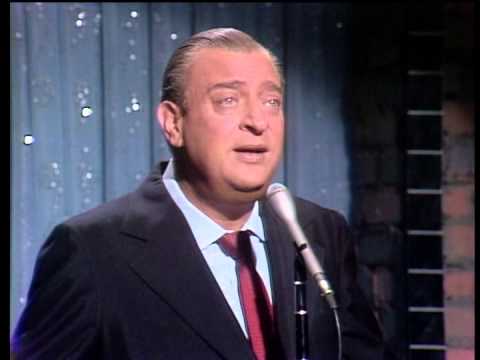
The Dean Martin Show: Rodney Dangerfield 1973 Standup: No Respect?


Source: Dino Forever- Comedian Rodney Dangerfield.
Source:The New Democrat

I never really got the Rodney Dangerfield no respect routine, I mean, I get it, but I guess I don't agree with it. Rod is seen as a working class hero's comedian with a very quick wit, a great sense of humor and a talent for  one-liners.  That is his background.  He is not Dean Martin,  Sammy Davis,  George Carlin, Richard Pryor, Johnny Carson or any of the other great comedians who have both great wit and  quick intelligence.  They kept up with current affairs and were always able to find the funny side in them.

Rod is sort of the king of the one-liners.  They are mostly about his own life.  A central theme is his perceived lack of respect from others.  He used that routine to make a hell of a career for himself but he's not in the same league as Johnny Carson and the others I listed above.  He's simply step or two below them.  I would compare him to someone like Andrew Dice Clay or maybe a Nick DiPaulo.  Dice, I believe, was inspired by Rodney.  They have similar routines. 

Bill Cosby is a perfect example of a superstar comedian who's at the top of heap, a so-called A-List  comedian.  At that next level, are comedians who are very funny and can always make you laugh but  the topics they cover, like everyday life or their own lives, put them a step or two behind the comedians who can make fun of entertainers, politicians, athletes, and or other celebrities because they keep up with those people and are very knowledgable about those subjects.

Rodney Dangerfield is at the second level, perhaps not B comedians but B+ or A-.  You can be a Hall of Fame athlete without being one of the top five players, or even in the top five percent of players, who ever played your sport, as long as you were one of the best of your era.  Rodney Dangerfield was a great comedian but not one of of the best all time.  He's not quite in that elite group. 
Source:Dino Forever

Sunday, April 6, 2014

Movie Clips: Airport 1975- The Best of the Disaster Movies


Source:Movie Clips- Alan Fudge, played an air traffic controller in Airport 1975.
Source:The New Democrat

"Airport 1975 Trailer - Directed by Jack Smight and starring Charlton Heston, Karen Black, George Kennedy, Efrem Zimbalist Jr., Susan Clark. A mid-air collision involving a a small plane and a commercial jetliner leads to potential disaster, as a plane loaded with passengers and no pilot becomes the worst nightmare for a flight attendant tasked with flying the craft."

From Movie Clips

To understand Airport 1975 you have to understand the times when the movie was made and the 1970s as a whole.  People were into this type of disaster movie.  Disaster movies were popular in this decade.  There's a laundry list of them, including Airport 1970 and its three sequels, including Airport 1975, Airport 1977, and Airport 1979.  Earthquake, also with George Kennedy and Charlton Heston, takes place in Los Angeles.

Americans, then as well as today, liked seeing people pushed to their limits with their lives and health at risk and not knowing if they will survive the experience.  In Airport 1975,  the head stewardess has to fly the plane herself, at one point.  This, and a mid-air transfer of a pilot between planes, are excellent examples of people under pressure pulling off extraordinary things when they have to.

The plot of Airport 1975 is fairly simple.  A 747 is flying through pretty awful rainy weather.  There is a small charter plane nearby that, apparently loses contact with the ground controllers.  These two planes do not know they are in the same area headed right at each other without enough warning to avoid collision. The pilot of the small plane has a heart attack and loses control.  His plane hits the 747 with its five-hundred, or so, passengers.

The collision kills the navigator and co-pilot.  The pilot survives but is blinded and barely conscious. There are no other pilots on the plane but, except for a hole in the cockpit, it is in decent shape and doesn't have to crash if someone can fly it.  The head stewardess (Karen Black)  conveys the situation the situation to the airline's command center.

She, with instructions, from Al Murdock (Charlton Heston) the company's chief aviation instructor,  flies the plane,  including pulling the it up so that it doesn't run into a mountain.  They attempt a mid-air transfer to get an actual pilot in the cockpit into the plane. The first attempt fails with the pilot falling to the ground.   The second attempt succeeds in inserting Murdock into the plane.  He takes over and saves the day, so to speak.

I'm a big fan of Airport 75, even though it is an airplane disaster movie.  It has a very funny cast, Sid Caesar, Jerry Stiller, Conrad Jannis, Normal Fell and others.  It's a well written movie with funny people making the best of a horrible situation, not knowing if they will ever be able to crack jokes on the ground again, and using humor to avoid going crazy in an extremely stressful situation.

Friday, April 4, 2014

Clint Eastwood: Heartbreak Ridge (1986)


Source:The New Democrat

Heartbreak Ridge is my favorite Clint Eastwood movie and that is saying something because there might be ten of his movies that I love, including Magnum Force, Dirty Harry, The Enforcer, The Gauntlet, Pink Cadillac, Thunderbolt and Lightfoot and a few others.  All of these movies have a few things in common: great stories, great writing, great casts and great quick-witted humor, all at times when you might think, "How could someone joke about that?"

Heartbreak Ridge was made in 1986 but takes place in 1983, about the time of the bombing of the marine barracks in Lebanon. Its about these lazy recon marines who are in the Marines to chill and have a good time.  They are basically still in boot camp, as far as their level of training goes, and are seen by the officers at their base in North Carolina as screw ups, which is putting it mildly.  Assholes would be more accurate.

Sergeant Tom Highway (Eastwood), a thirty year veteran of the Marine Corps who served in both the Korean and Vietnam wars, a distinguished member of the silent generation in this movie and in real life, is brought to this unit to get these assholes in shape and turn them into real marines.  The problem is that Sergeant Highway's superior officer, Major Powers, (Everett McGill) is an old school, by the book, tight ass who wants things done his way or no way.  Highway is not in the Marines to play by anyone else's book, so they clash.

Highway has to make these very young men, late twenties at the oldest, into marines with this tight ass major on his back the whole time and do it without losing his job.  He takes his unit into battle in Granada to rescue some Americans.  There are over two hours of this in the full version of the movie along with a lot of great humor from Eastwood and his crew.  Teenage boys, maturity wise, become good U.S. Marines

Wednesday, March 26, 2014

AEI: James Pethokoukis: The New Marxism


Source:The New Democrat

Winston Churchill famously said, "Democracy is the worst form of government except for all the rest." This logical form can be applied to other systems as well.

It works fairly well in economics, e.g., "Capitalism is the worst economic system except for all the rest."  Capitalism has many forms.  In one, Laisssez-Faire economics, government has no role in the economy and all capital is controlled by the private sector with no rules on how to operate. Whatever government exists is funded by trade tariffs.  This form was found seriously wanting and discarded at the end of the 19th century.

The beauty of capitalism, in whatever form, is that individuals are not guaranteed wealth.  They have to earn it.  This incentivizes them to get a good education and be productive in life so that they don't need public assistance to take care of them.  In a good capitalist economic system, as many people as possible are able to get the skills needed to be productive and successful in life.  Liberals, Conservatives, Progressives and Socialists have been arguing about this at least since the New Deal.

Even Socialists in Europe and in America now acknowledge that capitalism and private enterprise are here to stay.  The Marxists have lost, so the question now is what type of capitalist economic system should we have. I went into this on my blog yesterday but as a Liberal I believe in liberal capitalism or liberal economics.  Some on the far-left would call this "Neo-Liberalism" (because it is not Socialism). But it is is an economic system where, ideally, everyone has an opportunity to attain the  education needed to succeed in life. 

In such a system, the role of government is to protect workers and consumers not from themselves but from predators who would hurt them and to help people who fall though the floor of the system.  The  safety net exists to give them temporary financial relief and a hand up.  This is the outline of liberal capitalism. 


The Federalist: David Corbin & Matt Parks: Publius & The Progressives

I see two dominant political factions in the Democratic Party today.  The first is the FDR/LBJ progressives, who are not Socialists but real Democratic progressives in the best sense of the word. They believe that we should have an essentially free market economy that works for everyone and that there should be social insurance for people who fall through the cracks of the capitalist private enterprise system.  They believe in a big centralized government and tend not to trust the states but they also believe that there are limits to what government can do well for people.

The second is the JFK/WJC or Bill Clinton Liberals who are called New Democrats.  They believe that the safety net should just be there for the people who really need it.  They like the idea of states being able to run their own social insurance programs  and that these programs should primarily empower people to take care of themselves. These are the economic philosophies of the two factions.  They have been the dominant factions in the Democratic Party for over eighty years and the basis of the party's dominance over that period of time.

The people who are called Liberals and Progressives in America would probably be Conservatives in Canada or Britain and their center-left parties would look like our far-left parties, which brings me to my next point.  The Democratic Party changed in the mid and late 1960s as more baby boomers came of age and became Democrats.   The New-Left in America, today, is made up a lot of boomers and their kids.  They staffed the Occupy Wall Street movement. This far-left movement combines both socialist and anarchist (when they see certain laws as unjust) leanings.  They want a government large enough to see that no one is rich or poor, that we are all the same even if some of us are more productive and skilled than the rest.

The MSNBC talk lineup (is there anything else on MSNBC these days?) gets labeled as "progressive talk or progressive voices" when they are not ( and they sure as hell ain't liberal either!).  In actuality, they (except for Ed Schultz and to a certain extent Larry O'Donnell) speak for the Occupy Movement and the New-Left in America.   The rest of them, Rachel Maddow, Chris Hays, and Melissa Harris-Perry are, I'm sure, fine decent people but they are whacked out New-Leftists.  There are no limits to what they believe the government, especially the Federal government, can do for people.  They essentially believe that Americans should want to (and consider it an honor to)  pay Uncle Sam as much in taxes as necessary to take care of all us.

Friday, March 21, 2014

Hoover Institution: Uncommon Knowledge With Peter Robinson- Richard Epstein: 'Crisis & The Law'

Source:Hoover Institution- fellow Richard Epstein, on Uncommon Knowledge with Peter Robinson, in 2009.
Source:The New Democrat

"Considered one if the most influential legal thinkers of modern times, Richard Epstein brings his libertarian views to bear on the current financial crisis --government incentives were perverse, so the actions of the private parties were perverse-- and rates the performances of George Bush and Barack Obama in their responses to the crisis.  He speaks to the importance of contracts and the constitutionality of the expo facto taxation on AIG executives and the Employee Free Choice Act embraced by President Obama.  Finally he speaks of his personal and professional dealings with Barack Obama when they were law school faculty mates at the University of Chicago."

From the Hoover Institution

I guess because of the way I look at the United States Constitution, I would be described as a Liberal Constitutionalist, who looks at the entire Constitution and doesn't pick out parts that I like and rail against the parts that I do not like, which is common among both the Far-Left and far right in America.  Both the left and the right pick and choose the parts of the Constitution they favor and then claim they are upholding the Constitution, but see things they do not favor and support amending the Constitution for the good of the country, however they would phrase that.

I like the Constitution as a whole and am not interested in eliminating any of the amendments, but I might add an official Right to Vote to it as well as update the 1965 Voting Rights Act, which would throw out most of these so-called Voter ID laws that are really voter prevention laws. 

But there are parts of the U.S. Constitution that are my favorites, which is the real point of this post.  I'm going to concentrate on these because they protect our individual freedom and make us a liberal democracy.

What I really love most about the U.S. Constitution are the First Amendment, which guarantees our right to speech and assembly; the Fourth Amendment, which guarantees our right to privacy and protects our property rights, because it means that government can't come into our homes and businesses without what is called "probable cause" and cannot search our properties without a search warrant issued by a judge; and the Fifth Amendment, which again protects our property rights because government cannot take our property without  probable cause.

These rights allow Americans to live their own lives and associate with whom they choose just as long as they aren't hurting innocent people, and allows government to protect us from criminals and invaders but not to protect us from ourselves. As long as we aren't declaring war on the government or illegally leaking classified information, these rights give us autonomy over our own lives.  We should always remember this and not take them for granted. 

Thursday, March 20, 2014

Mundane Matt: Is Fred Phelps Dying?


Source:The New Democrat

I'm not going to say that I hope that Fred Phelps is dying (at least not in public).  That would simply not be the polite thing to do.  It is not consistent with our social mores to wish people to die.   You might think the world would be a better place if a certain person were dead, and Fred Phelps is the perfect example of such a person, but anyone who considers themselves civilized cannot publicly wish such a person to die.

But Fred Phelps dying.  If his organization goes out of business as a result, that would definitely be a great thing, not just for homosexuals or homosexual military personal but for the military in general and for anyone who hates bigots and bigotry.  It is indisputable that without Fred Phelps and his group, the world will be a better place.  Modern Christianity is against hate and hating people for having different lifestyles.  Christ said, "Love thy neighbor as thyself."