Liberal Democracy

Liberal Democracy
The Free State
Showing posts with label Gerald Ford Presidency. Show all posts

Thursday, August 14, 2014

Max Power: President Gerald Ford- Pardons Richard Nixon: September 8, 1974


Source:Major King- President Gerald R. Ford: 38th President of the United States.
Source:The New Democrat

"Newly inaugurated Gerald Ford pardons his predecessor Richard Nixon in the wake of the Watergate scandal."

From Major King

As unpopular as the pardoning of Richard Nixon was for President Gerald Ford in 1974 and contributed to President Ford losing the election in 1976, it was the right thing for the President to do. Because of all the problems that he inherited as President dealing with the economy with high inflation, high interest rates, the recession of 1974-75, a rising deficit, the ending of the Vietnam War with the Ford Administration having to bring American personal back home from Vietnam safely. President Ford had a lot on his plate already and didn't have time to deal with the Nixon case and prosecution.

Wednesday, July 30, 2014

CBS News: 'President Gerald Ford Talks Ronald Reagan On Face The Nation in 1976'


Source:CBS News- President Gerald R. Ford (Republican, Michigan) talking to CBS News Face The Nation, in 1976.

Source:The New Democrat 

"President Gerald Ford talks about the possible nomination of Ronald Reagan for president, and the possibility of Reagan as Ford's running mate on the June 6, 1976 edition of Face the Nation. Ford's eventual running mate was Robert Dole, and they lost to Jimmy Carter and Walter Mondale. (CBS NEWS)" 

From CBS News

President Gerald Ford trying to run as a centrist in 1976 even though he had a pretty conservative record in Congress as a Representative from Grand Rapids, Michigan and as House Minority Leader. And then had a pretty conservative record as President especially when it came to fiscal policy and taxes. But also as it related to foreign policy and national security. But Ronald Reagan saw President Ford as not tough enough when it came to Russia and foreign policy in general and was a basis for running against him in 1976.

Saturday, December 21, 2013

President Gerald R. Ford: State of The Union Address (January 12, 1977)

Source:James Miller Center- President Gerald R. Ford (Republican, Michigan) 38th POTUS (1974-77)
Source:The New Democrat 
"President Ford gives his final State of the Union Address, bidding his farewell to Congress and describing the strength of the United States and what must be done to make further improvements.

"The initials synonymous with the Republican Party—“GOP”—stand for “grand old party.” As early as the 1870s, politicians and newspapers began to refer to the Republican Party as both the “grand old party” and the “gallant old party” to emphasize its role in preserving the Union during the Civil War. The Republican Party of Minnesota, for instance, adopted a platform in 1874 that it said “guarantees that the grand old party that saved the country is still true to the principles that gave it birth.” 

In spite of its nickname, though, the “grand old party” was only a mere teenager in the early 1870s since the Republican Party had been formed in 1854 by former Whig Party members to oppose the expansion of slavery into western territories." 

Source:History- and The Grand Ole Party.

From History 

I put that Grand Ole Party quote and link in this piece for an excellent reason: The Grand Ole Party is Gerald Ford's party. His job was to restore and preserve, or conserve (if you prefer) confidence in the American form of government and our constitution, after the Watergate debacle of 1972-73, that led to President Richard Nixon's resignation in 1974. And he did a great job of doing just that.

There have been times in American history when if America didn't have a certain person as President, it wouldn't been clear if they could've survived as a country gotten through that crisis. I'm thinking of: 

Abraham Lincoln during the Civil War

Franklin Roosevelt during the Great Depression and World War II 

Lyndon Johnson during the civil rights movement

And yes, Gerald R. Ford during the post-Watergate period during the mid-1970s

Now, maybe the country would've survived during those periods with someone else as President, but we would've been a lot worst off. 

Of course as a Conservative Republican, Gerry Ford was partisan. He was House Minority for almost 9 years, Vice President and then President of the United States and Leader of the Republican Party. But he wasn't President as a partisan. He knew the situation that he inherited and knew what his job was, which was to restore order and confidence in the American system and form of government. 

There are plenty of people who think that Gerry Ford was a great man and a good President. I'm a Democrat, but I'm one of those people. But almost no one (Democrat or Republican) thinks that Gerry Ford was a bad man. And we're talking about someone who served in the U.S. Government for over 30 years, if you count his military service during World War II.  

This post was updated June 14, 2023.

Monday, September 16, 2013

James Miller Center: President Gerald Ford: Address on Energy Policy (1975)

Source:James Miller Center- President Gerald R. Ford (Republican, Michigan) speaking about energy policy in 1975.
Source:The FreeState

"President Gerald Ford proposes ways to address the growing energy crises, and criticizes the Democratic-led Congress for refusing to let him move on energy reform.

May 27th, 1975" 


"Gerald Ford

May 27, 1975

Source National Archives
President Ford addresses the American people to discuss his efforts to pass an energy policy bill. He points to a lack of cooperation by Congress to enact any legislation to make the United States less dependent on foreign oil, conserve energy, and increase domestic production. The President and Congres eventually reach an agreement in December 1975 with the passage of the Omnibus Energy Bill." 


President Ford, showing a lot of leadership in 1975, taking on energy policy and even energy independence, figuring out that the energy shortages of the early and mid 1970s were bad for the economy as a whole. Not just energy production, as well as our foreign policy having to rely on other countries that aren’t very dependable, to provide a huge superpower with energy. And that if America could produce more energy on our own, it would benefit both our economy as well as foreign policy. 

The Great Deflation, is how you could sum up the American economy in the 1970s. Part of that having to do with the fact that even though America has about the most natural resources in the world, perhaps only Russia, has the ability to produce more energy for their own country than America and yet we were dependent on other countries for our energy supply. Because we haven’t up until lately, the last few years, done a very good job of developing all of our energy industries. Oil, gas, natural gas, nuclear, solar and wind. 

We produce all of these resources and have the ability to be leaders in all of these resources in the world and become energy independent. But haven’t done a very good job of moving these energy resources along.

Tuesday, February 12, 2013

James Miller Center: President Gerald R. Ford; 1975 State of the Union

Source:James Miller Center- President Gerald R. Ford: 1974 State of the Union address to Congress.
"(Part One) President Gerald R. Ford's State of the Union Address - January 15, 1975

Video Courtesy of the Miller Center of Public Affairs and the Gerald R. Ford Presidential Library."

From the James Miller Center

President Gerald Ford's 1975 State of The Union address was interesting for several reasons. First of all it was his first one since becoming President of The United States. So it was his first opportunity to layout in front of a huge audience in front of Congress on national TV, in prime time what he believes the situation of the country is and where he wants to take the the country, what his administration would be focused on since becoming President of The United States in August, 1974 after President Richard Nixon resigned because of Watergate with Gerry Ford being Vice President of The United States before that.

So this speech was President Ford's opportunity to layout for the country what type of politician he was and what type of Republican he was, what he believed in and where he was ideologically and who he was politically. And if you listen to one of the first lines of this speech, he says the State of The Union is not strong. High inflation, interest rates, budget deficit, too many people being unemployed and so-forth. So the American people got to see how honest he was as a leader.

Again, a State of The Union speech is an opportunity for the President of The United States to not only layout what he believes the situation of the country is, but where he wants to take the country and what he wants to accomplish. And with the speech you hear a Conservative Republican President who is focused on the economy and fiscal policy. Too many people out-of-work, a weak economy that went into recession in 1974-75, with a rising budget deficit. And you also hear his solutions for it with an across the board tax cut to respond to it.

But another interesting thing about the speech is that you hear both the economic and fiscal Conservative. Gerry Ford speech which separates him from President Reagan: "We need greater economic freedom and lower taxes.) but we also have to pay for our expenditures by cutting the budget. Because this tax cut won't pay for itself. Unlike with President Reagan who was a supply sider when it came to economic policy and believed that tax cuts pay for itself.

There are a lot of things I like and respect about Gerry Ford the man and politician. The man was one of the most decent, and honest politicians as well as public servants we've ever had. He came from the Harry Truman/Dwight Eisenhower school of public service as far as how public officials should talk to people. But he was also the real thing politically. A Conservative who was actually Conservative, because he knew what conservatism actually was. Rather than someone whose further to the right, but called themselves a Conservative.

Tuesday, August 28, 2012

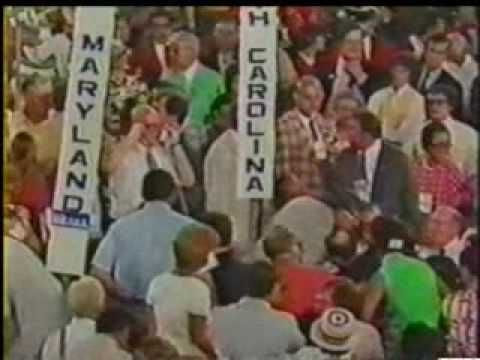
CBS News: 1976 Republican Party Convention


Source:CBS News- covering the 1976 Republican Party convention, at Kemper Arena in Kansas City, Missouri.

"1976 GOP Convention. Lot of drama."

From Mike Gardner

I think what this was about is that President Gerald Ford (Republican, Michigan) had a slight lead on delegates, but enough to win the nomination for President, if the Republican Convention just voted. But what Ronald Reagan's campaign was trying to do was to get more delegates and try to switch votes from Ford to Reagan and win the nomination that way. 

President Ford got off to a great start in 1976 as far as winning Republican delegates, putting him in strong shape to win the nomination. And then Governor Reagan came on late to make this nomination fight not just close, but close enough to essentially split the Republican Party between establishment Conservatives and Progressives Republicans for Ford and populist Republicans for Reagan.

Thursday, August 9, 2012

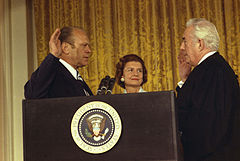
Chuck Phillips: 'Gerald R. Ford Speech On Assuming The Presidency'

Source:Chuck Phillips- Gerald R. Ford (Republican, Michigan) becoming the 38th President of the United States, in 1974.
"Gerald Ford begins to heal the nation of Watergate." 


"Nixon's resignation was tendered to United States Secretary of State Henry Kissinger at 11:35 a.m. At that moment, Ford became the 38th president of the United States, although he took the official oath of office at 12:05 p.m. Once the former president (and now private citizen) Nixon left the building, the White House staff began preparations for Ford's swearing-in. More chairs were added for the much larger crowd of invited guests than was at the farewell. The oath was administered to Ford by Chief Justice Warren E. Burger in the White House East Room. Chief Justice Burger was traveling in the Netherlands at the time, and was flown back to Washington, D.C., on an Air Force plane.[6] The first phone call that President Ford, a former center on the University of Michigan football team, made after his inauguration was on Saturday, August 10, 1974, to Ohio State University football coach Woody Hayes, who had just recently suffered a heart attack." 

Source:Wikipedia- Gerard R. Ford (Republican, Michigan) becoming the 38th President of the United States, in August, 1974.

From Wikipedia

On August, 9th 1974 Gerald R. Ford who was Vice President of the United States up until assuming the Presidency, assumed the Presidency of the United States. A job he never wanted or campaigned for prior to becoming president. 

Gerry Ford's big goal in politics was to be Speaker of the House of Representatives. A job as Minority Leader of the House of Representatives from 1965-73, came within twenty seats or so, after running for Speaker five times. He didn't want to be Vice President either, he got that job after Vice President Spiro Agnew resigned in 1973 due to a corruption scandal of his own.

Then Minority Leader Ford, was appointed Vice President in 1973 to replace Spiro Agnew, because House Speaker Carl Albert and Senate Leader Mike Mansfield, both Democrats both told President Nixon that Ford had the most votes and trust of any Republican in Congress. And would be someone that both Democrats and Republicans would vote to confirm in both the House and Senate. 

As Ford was confirmed by both the House and Senate overwhelmingly for Vice President in December 1973. And as it turns out Gerry Ford was the right choice if not best choice to be Vice President, because of his credibility with Congress and the country.

When Gerry Ford became Vice President in 1973, both Democrats knew that he was going to be the next President of the United States. As well as the media, because they all knew that Richard Nixon's days as President were numbered, that he wouldn't finish out his term as President. And what was about to come down and came down in 1974 in the Watergate scandal points that out perfectly. So appointing Ford as Vice President, President Nixon also probably knew or believed that he was appointing the next President of the United States as well.