Liberal Democracy

Liberal Democracy
The Free State

Wednesday, September 26, 2012

Discovery: 'The Proud History of the Republican Party'

Source:Discovery- with a look at a Republican Party that almost doesn't exist at all anymore.

"The Republican Party formed by abolitionists in 1854 take bold steps in securing freedoms for former slaves until the Democrats regain control of Congress. Once in control of Congress and many of the southern state governments the Democrats once again stripped away the rights African Americans wouldn't again fully achieve until the civil rights movement of the 1960's.

- In 1865, Congressional Republicans unanimously backed the 13th Amendment, which made slavery unconstitutional. Among Democrats, 63 percent of senators and 78 percent of House members voted: "No."

- In 1866, 94 percent of GOP senators and 96 percent of GOP House members approved the 14th Amendment, guaranteeing all Americans equal protection of the law. Every congressional Democrat voted: "No."

- February 28, 1871: The GOP Congress passed the Enforcement Act, giving black voters federal protection.

- February 8, 1894: Democratic President Grover Cleveland and a Democratic Congress repealed the GOP's Enforcement Act, denying black voters federal protection.

- October 16, 1901: GOP President Theodore Roosevelt invited to the White House as its first black dinner guest Republican educator Booker T. Washington. 

- January 26, 1922: The U.S. House adopted Rep. Leonidas Dyer's (R., Mo.) bill making lynching a federal crime. Filibustering Senate Democrats killed the measure.

- Until 1935, every black federal legislator was Republican. America's first black U.S. Representative, South Carolina's Joseph Rainey, and our first black senator, Mississippi's Hiram Revels, both reached Capitol Hill in 1870. On December 9, 1872, Louisiana Republican Pinckney Benton Stewart "P.B.S." Pinchback became America's first black governor.

- August 17, 1937: Republicans opposed Democratic President Franklin Delano Roosevelt's Supreme Court nominee, U.S. Senator Hugo Black (D., Al.), a former Klansman who defended Klansmen against race-murder charges.

- September 24, 1957: Eisenhower deployed the 82nd Airborne Division to desegregate Little Rock's government schools over the strenuous resistance of Governor Orval Faubus (D., Ark.).

- May 6, 1960: Eisenhower signs the GOP's 1960 Civil Rights Act after it survived a five-day, five-hour filibuster by 18 Senate Democrats.

- November 2, 1983: President Reagan established Dr. Martin Luther King Jr.'s birthday as a national holiday, the first such honor for a black American.

- President Reagan named Colin Powell America's first black national-security adviser while GOP President George W. Bush appointed him our first black secretary of state.

Facts are from Deroy Murdock who  is an advisory board member of Project 21, a Washington-based network of black free-market advocates." 

From RCO 64 

The Republican Party has never been a left-wing, or even center-left, social democratic party. They've always been, for the most part (with perhaps today being the exception) a center-right, pro-constitution, pro-limited government, pro-fiscal responsibility, pro-individual, pro-national security, pro-rule of law party, that would fit in very well with most center-right parties, at least in the developed world. 

But pre-Christian-Right, pre-Tea Party populists, the Republican Party had a strong right-progressive faction, led by Tom Dewey, Dwight Eisenhower, Nelson Rockefeller, Richard Nixon, even, that believed in civil rights for all Americans and that all Americans should have the same constitutional, individual rights and responsibilities, as every other American, including African-Americans and women of all racial and ethnic backgrounds. 

The reason why the Republican Party got the nickname the Grand Ole Party, because they were a big tent party with a strong classical conservative faction in it, that's always been there, to go along with a strong right-progressive faction in it. And why they were the Party of Abraham Lincoln that freed the African slaves and gave them the same constitutional rights as European-Americans, including Souther-Anglo-Saxon-Protestant men in this country. That Republican Party is all but gone today.

Sunday, September 23, 2012

CBS News: The Longine Chronoscope- U.S. Senator Everett Dirksen (1952)


Source:CBS News- U.S. Senator Everett Dirksen (Republican, Illinois) on The Longines Chronoscope in 1952.
“LONGINES CHRONOSCOPE WITH SEN. EVERETT M. DIRKSEN – National Archives and Records Administration 1952-05-07 – ARC Identifier 95971 / Local Identifier LW-LW-417 – TELEVISION INTERVIEW: William Bradford Huie and Donald I. Rogers talk with Sen. Dirksen on his Senate bill to limit the powers of the Wage Stabilization Board, government seizure of steel industry, credit controls, and the presidential campaign 1952. Copied by IASL Master Scanner Thomas Gideon.” 


Members of Congress in both parties are always looking to weaken executive power (until they become President themselves) specially since President’s are always looking to increase executive power. Which is what this debate is about and what Senator Dirksen was trying to do to have the members of this board having to all be approved by the U.S. Senate.

During the 1930s the Roosevelt Administration under the New Deal, created all sorts of new programs, boards, agencies that had jurisdiction over the economy. And what Senator Dirksen wanted to do was to have these boards and board members have to be approved by the Senate. With both the Senate and House having Congressional oversight over these boards.

Many of these boards and agencies that were created by the New Deal were permanent boards and agencies. The President can put together short-term commissions and boards to study issues and come up with policy proposals and these things are put together all the time. But these commissions don’t have subpoena power generally and can’t issue new rules and regulations that business’s and individuals have to comply with.

What Senator Dirksen wanted to do here with this board since it was permanent with regulatory power was to have the members be approved by the Senate and have to report to Congress both the House and Senate.

This interview was done in 1952 when the country was at peace for the most part even though we were involved in the Korean Civil War. And the economy that was in depression for most of the 1930s and came out of that and recovered in the 1940s thanks to World War II.

Senator Dirksen’s line in this interview about “fake prosperity” had to do with the fact that the American economy was booming at this point, because we were at war and had so many me oversees and fighting. Which created millions of jobs at home with so many men out of the country. Plus with all the middle class jobs that were created at home to fight World War II and then later the Korean War. And I guess Senator Dirksen was saying that America wouldn’t have the prosperity at home if we weren’t fighting abroad.  

You can also see this post on WordPress.

You can also see this post at The Daily Post, on WordPress. (No pun intended) 

You can also see this post at The Daily Post, on Blogger. (No pun intended)

Friday, September 21, 2012

The Gary DeMar Show: Gary North: 'The Bulwarks of the Conservative Movement'


Source:The Gary DeMar Show- Conservative author Gary North.

"The key book that led the conservative movement in the 20th century was "The Road to Serfdom" by the author F. A. Hayek. On the other end of the economic philosophical spectrum was John Maynard Keynes. These two economists were friends at Cambridge, but they were both battling for the economical worldviews of British leadership. Hayek's book was made popular when Reader's Digest chose to write a summary article of the book. This launch the conservative ideas into the public sphere, ultimately into popular reading of the intellectual American right. Accelerating the impact of Hayek's book was Henry Hazlitt's "Economics in One Lesson," that was published a year later. These two books forced a complete rethinking of the war time economics and 'the new deal.'

In this video, Gary DeMar interviews Dr. North (in six parts) about his brand new DVD series "The History of the Conservative Movement" (available now at AmericanVision.com). This is part five of the six parts of this interview." 


I think it's important that people know what you are talking about and that you know what you are talking about when you use phrases and terms like the conservative movement. You need to know what you are talking about when you say conservative movement to people and whoever you are talking too or listens to you, when you say the conservative movement. 

Whether you are talking about Conservative Libertarians or Classical Conservatives, or even people that I at least like to call Progressive Republicans or Right-Progressives, or you are talking about the so-called Christian-Right, people who are right-wing populists in America, you have to know that all these factions are not part of the same so-called conservative movement. 

Conservative Libertarians or Classical Conservatives are more conservative than the Christian-Right on the Constitution, limited government, economic policy and national security. And Right-Progressives are also more conservative than the Christian-Right on the Constitution, limited government, and national security. 

The Christian-Right is obviously to the right of Classical Conservatives and Right-Progressives on social policy and want a bigger government and even a bigger national government, with a lot more restrictions on how individuals can live when it comes to social policy and social issues.

I don't think there's such thing in America as a conservative movement, unless you are talking about conservatism in a classical and constitutional sense and people who believe in conserving the U.S. Constitution, our limited, Federal form of government, with all the individual rights and rule of law that comes from our form of government and our Constitution. 

I believe there are several rightist movements in America from the Center-Right, where I tend to be ideologically, to the right-wing, and the Far-Right in America, where the Christian-Right, Nationalists, and Neo-Confederates tend to be ideologically.

You can also see this post on WordPress.

Wednesday, September 19, 2012

Romney Comms: U.S. Representative Paul Ryan: 'Hard Work, Not Redistribution, Built Our Economy'


Source:Romney Comms- U.S. Representative Paul Ryan (Republican, Wisconsin) 2012 Republican Vice Presidential nominee.

"Paul Ryan: Hard Work, Not Redistribution, Built Our Economy" 

From Romney Comms

I'm thinking Representative Paul Ryan already knows this, but he's a hyper-partisan, Republican politician, so for political reasons tends to ignore this. But everything that government does is a form a wealth redistribution. 

Looks like Representative Ryan was campaigning at an American military base. Guess what, taxes that were paid in another part of the country, like in a different state, region even, were used to pay and keep that military case up and running, and to pay all the salaries and benefits of everyone that works at that military base. It's just sloppy, political rhetoric for Paul Ryan or any other politician to say that they're against wealth redistribution, when they're obviously not.

Wednesday, September 12, 2012

Romney Comms: U.S. Representative Paul Ryan: 'PEACE THROUGH STRENGTH WORKS'


Source:Romney Comms- U.S. Representative Paul Ryan (Republican, Wisconsin) 2012 Republican Party Vice Presidential nominee.

"PAUL RYAN: "PEACE THROUGH STRENGTH WORKS" 

From Romney Comms

Looks like Representative Paul Ryan has his Republican, foreign policy and national security talkings points locked down. In his entire 14 years in the House, his whole background and resume there has been about fiscal and economy policy, social welfare. Not foreign policy and national security, even though as Chairman of the Budget Committee, I'm sure he has some awareness about the defense budget and how our defense tax dollars are spent, you can't seriously call him a foreign policy and national security expert. But apparently he has heard about peace through strength at some point during his time in Washington.

Wednesday, August 29, 2012

EFAN 2011: Richard Nixon's- 1968 GOP Presidential Acceptance Speech: The Silent Majority

Source:EFAN- Richard Nixon, accepting the Republican Party's 1968 nomination for President.
"Here is Nixon's Acceptance Speech from the 68 RNC. He was the man to beat in 68...

I also have radio coverage of the roll call that I will upload here in a bit."

From EFAN

The 1960s was actually a pretty good time for America even though we were very divided as a country over Vietnam, civil rights and the Great Society. 

The Civil Rights Act was passed in 1964 which outlawed racial discrimination under law in the United States. 

The Voting Rights Act was passed in 1965. Which meant no longer would be people be denied their right to vote based on their race. 

The Fair Housing Law was passed in 1968. Which meant no longer would people be allowed to deny other people housing based on race. 

Medicare was passed in 1965, which meant seniors would always have guaranteed health insurance in America.

The economy boomed in the 1960s. The Federal Government was actually able to balanced its budget during this decade. 

But the 1960s was also one of the most turbulent and divisive decades we've ever had in America. Four political leaders were assassinated in this decade: President Kennedy, Malcolm X, Rev. Dr. Martin L. King and of course Senator Robert Kennedy in 1968. King and Kennedy in 68, within two months, April and June. Hundreds of thousands of Americans dying or injured in the Vietnam War, the South moving from solidly Democratic to solidly Republican in 1968.

Richard Nixon understood the mood of America about as well as any politician we've ever produced. And understood where the country was and where they were going and how he could fit in that into his politics as far as what he believed and what he wanted to accomplish. And he could make that work politically for him and the Republican Party. This whole speech is a perfect example of that, where he says: "That a country thats run by the rule of law, has lawlessness throughout the country." He's talking about the riots in our big cities like Detroit, Chicago, Los Angeles, and others.

Richard Nixon also said in 1968: "When the a country with the greatest military in the world gets bogged down in a civil war in a third world country (he's talking about the Vietnam War) when these things happen its time for a change in leadership in the greatest country in the world." Meaning the United States. 

Dick Nixon laid out where the country was, all the divisiveness that the country was going through. And what wasn't working in the country and saying it's time for a change in leadership in America. And saying he's the one meaning who will bring that new leadership that will move America forward.

Tuesday, August 28, 2012

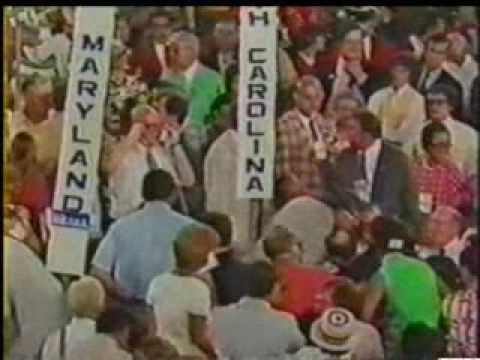
CBS News: 1976 Republican Party Convention


Source:CBS News- covering the 1976 Republican Party convention, at Kemper Arena in Kansas City, Missouri.

"1976 GOP Convention. Lot of drama."

From Mike Gardner

I think what this was about is that President Gerald Ford (Republican, Michigan) had a slight lead on delegates, but enough to win the nomination for President, if the Republican Convention just voted. But what Ronald Reagan's campaign was trying to do was to get more delegates and try to switch votes from Ford to Reagan and win the nomination that way. 

President Ford got off to a great start in 1976 as far as winning Republican delegates, putting him in strong shape to win the nomination. And then Governor Reagan came on late to make this nomination fight not just close, but close enough to essentially split the Republican Party between establishment Conservatives and Progressives Republicans for Ford and populist Republicans for Reagan.