Liberal Democracy

Liberal Democracy
The Free State

Friday, September 21, 2012

The Gary DeMar Show: Gary North: 'The Bulwarks of the Conservative Movement'


Source:The Gary DeMar Show- Conservative author Gary North.

"The key book that led the conservative movement in the 20th century was "The Road to Serfdom" by the author F. A. Hayek. On the other end of the economic philosophical spectrum was John Maynard Keynes. These two economists were friends at Cambridge, but they were both battling for the economical worldviews of British leadership. Hayek's book was made popular when Reader's Digest chose to write a summary article of the book. This launch the conservative ideas into the public sphere, ultimately into popular reading of the intellectual American right. Accelerating the impact of Hayek's book was Henry Hazlitt's "Economics in One Lesson," that was published a year later. These two books forced a complete rethinking of the war time economics and 'the new deal.'

In this video, Gary DeMar interviews Dr. North (in six parts) about his brand new DVD series "The History of the Conservative Movement" (available now at AmericanVision.com). This is part five of the six parts of this interview." 


I think it's important that people know what you are talking about and that you know what you are talking about when you use phrases and terms like the conservative movement. You need to know what you are talking about when you say conservative movement to people and whoever you are talking too or listens to you, when you say the conservative movement. 

Whether you are talking about Conservative Libertarians or Classical Conservatives, or even people that I at least like to call Progressive Republicans or Right-Progressives, or you are talking about the so-called Christian-Right, people who are right-wing populists in America, you have to know that all these factions are not part of the same so-called conservative movement. 

Conservative Libertarians or Classical Conservatives are more conservative than the Christian-Right on the Constitution, limited government, economic policy and national security. And Right-Progressives are also more conservative than the Christian-Right on the Constitution, limited government, and national security. 

The Christian-Right is obviously to the right of Classical Conservatives and Right-Progressives on social policy and want a bigger government and even a bigger national government, with a lot more restrictions on how individuals can live when it comes to social policy and social issues.

I don't think there's such thing in America as a conservative movement, unless you are talking about conservatism in a classical and constitutional sense and people who believe in conserving the U.S. Constitution, our limited, Federal form of government, with all the individual rights and rule of law that comes from our form of government and our Constitution. 

I believe there are several rightist movements in America from the Center-Right, where I tend to be ideologically, to the right-wing, and the Far-Right in America, where the Christian-Right, Nationalists, and Neo-Confederates tend to be ideologically.

You can also see this post on WordPress.

Wednesday, September 19, 2012

Romney Comms: U.S. Representative Paul Ryan: 'Hard Work, Not Redistribution, Built Our Economy'


Source:Romney Comms- U.S. Representative Paul Ryan (Republican, Wisconsin) 2012 Republican Vice Presidential nominee.

"Paul Ryan: Hard Work, Not Redistribution, Built Our Economy" 

From Romney Comms

I'm thinking Representative Paul Ryan already knows this, but he's a hyper-partisan, Republican politician, so for political reasons tends to ignore this. But everything that government does is a form a wealth redistribution. 

Looks like Representative Ryan was campaigning at an American military base. Guess what, taxes that were paid in another part of the country, like in a different state, region even, were used to pay and keep that military case up and running, and to pay all the salaries and benefits of everyone that works at that military base. It's just sloppy, political rhetoric for Paul Ryan or any other politician to say that they're against wealth redistribution, when they're obviously not.

Wednesday, September 12, 2012

Romney Comms: U.S. Representative Paul Ryan: 'PEACE THROUGH STRENGTH WORKS'


Source:Romney Comms- U.S. Representative Paul Ryan (Republican, Wisconsin) 2012 Republican Party Vice Presidential nominee.

"PAUL RYAN: "PEACE THROUGH STRENGTH WORKS" 

From Romney Comms

Looks like Representative Paul Ryan has his Republican, foreign policy and national security talkings points locked down. In his entire 14 years in the House, his whole background and resume there has been about fiscal and economy policy, social welfare. Not foreign policy and national security, even though as Chairman of the Budget Committee, I'm sure he has some awareness about the defense budget and how our defense tax dollars are spent, you can't seriously call him a foreign policy and national security expert. But apparently he has heard about peace through strength at some point during his time in Washington.

Wednesday, August 29, 2012

EFAN 2011: Richard Nixon's- 1968 GOP Presidential Acceptance Speech: The Silent Majority

Source:EFAN- Richard Nixon, accepting the Republican Party's 1968 nomination for President.
"Here is Nixon's Acceptance Speech from the 68 RNC. He was the man to beat in 68...

I also have radio coverage of the roll call that I will upload here in a bit."

From EFAN

The 1960s was actually a pretty good time for America even though we were very divided as a country over Vietnam, civil rights and the Great Society. 

The Civil Rights Act was passed in 1964 which outlawed racial discrimination under law in the United States. 

The Voting Rights Act was passed in 1965. Which meant no longer would be people be denied their right to vote based on their race. 

The Fair Housing Law was passed in 1968. Which meant no longer would people be allowed to deny other people housing based on race. 

Medicare was passed in 1965, which meant seniors would always have guaranteed health insurance in America.

The economy boomed in the 1960s. The Federal Government was actually able to balanced its budget during this decade. 

But the 1960s was also one of the most turbulent and divisive decades we've ever had in America. Four political leaders were assassinated in this decade: President Kennedy, Malcolm X, Rev. Dr. Martin L. King and of course Senator Robert Kennedy in 1968. King and Kennedy in 68, within two months, April and June. Hundreds of thousands of Americans dying or injured in the Vietnam War, the South moving from solidly Democratic to solidly Republican in 1968.

Richard Nixon understood the mood of America about as well as any politician we've ever produced. And understood where the country was and where they were going and how he could fit in that into his politics as far as what he believed and what he wanted to accomplish. And he could make that work politically for him and the Republican Party. This whole speech is a perfect example of that, where he says: "That a country thats run by the rule of law, has lawlessness throughout the country." He's talking about the riots in our big cities like Detroit, Chicago, Los Angeles, and others.

Richard Nixon also said in 1968: "When the a country with the greatest military in the world gets bogged down in a civil war in a third world country (he's talking about the Vietnam War) when these things happen its time for a change in leadership in the greatest country in the world." Meaning the United States. 

Dick Nixon laid out where the country was, all the divisiveness that the country was going through. And what wasn't working in the country and saying it's time for a change in leadership in America. And saying he's the one meaning who will bring that new leadership that will move America forward.

Tuesday, August 28, 2012

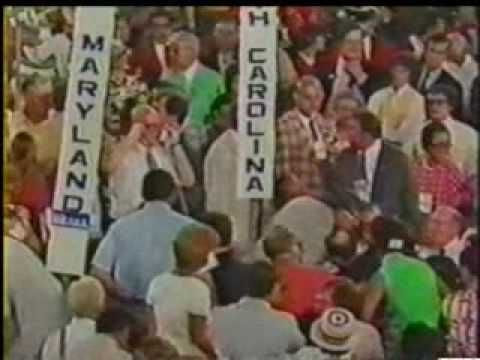
CBS News: 1976 Republican Party Convention


Source:CBS News- covering the 1976 Republican Party convention, at Kemper Arena in Kansas City, Missouri.

"1976 GOP Convention. Lot of drama."

From Mike Gardner

I think what this was about is that President Gerald Ford (Republican, Michigan) had a slight lead on delegates, but enough to win the nomination for President, if the Republican Convention just voted. But what Ronald Reagan's campaign was trying to do was to get more delegates and try to switch votes from Ford to Reagan and win the nomination that way. 

President Ford got off to a great start in 1976 as far as winning Republican delegates, putting him in strong shape to win the nomination. And then Governor Reagan came on late to make this nomination fight not just close, but close enough to essentially split the Republican Party between establishment Conservatives and Progressives Republicans for Ford and populist Republicans for Reagan.

Monday, August 27, 2012

Reagan Foundation: Ronald Reagan- ‘A Time For a Choosing (1964)’

Source:Reagan Foundation- private citizen Ronald W. Reagan speaking in favor of Senator Barry Goldwater, in 1964.

“The Speech” is what Ronald Reagan called it. Today we call it, “A Time for Choosing,” and it was a pivotal turning point in Ronald Reagan’s life.

Ronald Reagan began a long side-career of public speaking as his acting career closed out. He traveled across the country meeting Lions Clubs, Rotary Clubs, Chambers of Commerce and any other civic-minded local groups. This continued and intensified during his service as the General Electric spokesperson while hosting their sponsored television series. “The Speech” was delivered in various forms and to different audiences as each word was honed, measured and memorized.
During the 1964 Presidential campaign, Republican party officials in California, who knew Reagan’s powerful message and delivery, asked him to film a speech on behalf of the Republican candidate, Barry Goldwater. The speech was aired on October 27, 1964 and it was electrifying. Donations to the Republican party and candidates increased dramatically.

The Republican Party took note and they targeted Reagan as a candidate from that point forward. He agreed in 1966 to run for Governor of California. He won two terms, and eventually won the Presidency.”

From the Reagan Foundation 

The so-called Reagan Revolution of 1980, that brought Ronald Reagan to the presidency and thirty or so new House Republicans and the Senate Republicans winning control of the Senate for the first time since 1952, actually started in 1964 under Barry Goldwater. Ron Reagan just had the personality to sell American conservatism to the country and show Americans that it wasn’t scary. It took really sixteen years for the Republican Party to control both the White House and at least one chamber of Congress.

But all of these steps were put in place starting in 1964, when the message was put together. When Republicans started winning in the South consistently in 1966, a big reason Richard Nixon was elected President in 1968, won a landslide in 1972, because Southerners were becoming Republicans. The Democratic Party was losing its grasp on the South and hasn’t gotten it back since. Congressional Republicans lost overwhelmingly in Congress in 1974, but a lot of that had to do with Watergate.

Republicans lost again in at least partially due to Watergate 1976 and Ron Reagan ran for President in 1976. And came damn close to winning the Republican nomination from President Gerry Ford and kept this message of individual freedom and personal responsibility alive. The tax revolt of the late 1970s, especially in California, all of these things were part of the Goldwater/Reagan Revolution. Thanks to Barry Goldwater, the Republican Party was changing from a yes fiscally conservative, socially moderate party.

The GOP was mostly in the Northeast and Midwest and became a party that was able to communicate this message across the country and take this message to the South. The only thing with the South, is they brought in the Religious-Right to go along with Republicans who are more libertarian than statist when it comes to social issues. But the GOP understood that they were simply too small and had to grow their base to compete with Democrats in the future. 

You can also see this post on WordPress.

Friday, August 24, 2012

CNBC: 'Paul Ryan Talks Health Care With Howard Dean & John Sheils'


Source:CNBC- Governor Howard Dean (Democrat, Vermont) John Sheils and U.S. Representative Paul Ryan (Republican, Wisconsin) debating health care reform on CNBC.

"Paul Ryan: Governor, the Congressional Budget Office [CBO] is telling us that the House bill doesn't address health inflation. Youve been very outspoken on that, and I want to compliment you on that, but the House bill doesnt address health inflation. According to the CBO, the expenses of the public plan go up 8% a year - thats more than even Medicare and Medicaid grow.

So what the CBO is telling us is were creating a huge new unfunded liability that even if this thing is paid for in the first ten years [which it wont be], after that youre going to a massive new unpaid-for entitlement on top of all the other ones weve already got. It wont address health inflation.

I worry that were not actually addressing the root cause of our problem, which is health inflation, which you and I really want to tackle." 


I think the key points here are choice, competition, and a level playing field when it comes to health care and health insurance reform in America. And you could do that with allowing non-seniors to pay into Medicare and use it as their main health insurer, as well as letting the states, instead of the Feds, manage this expansion of Medicare for their non-seniors, including young working adults, unemployed workers, as well as juveniles. But that this Medicare expansion or public option has to compete fairly and play by the same rules as every non-profit health insurer in America.